


[Originally posted on LinkedIn on 21st August 2025]
What can sheep teach us about material design? A new paper in Advanced Functional Materials shows that the answer is a lot.
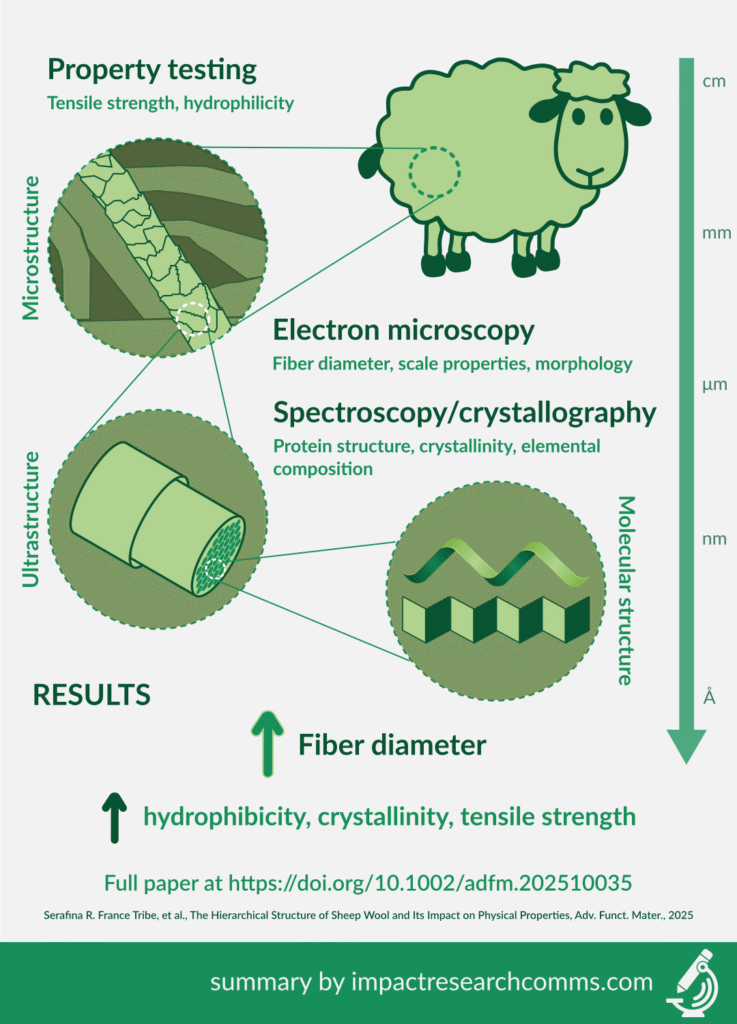
The study explores 16 wool fibre types from different sheep breeds and characterises them at different length scales, from observable macroscale features, such as length and crimp, to nanoscale properties of protein crystallinity and elemental composition.
By comparing the structure of the different wools to their mechanical properties, the authors were able to derive relationships between a fibre’s structure and its properties.
As fibre diameter increases:
- Wool becomes increasingly hydrophobic
- Individual fibres pack closer together, increasing crystallinity
- Tensile strength increases until a critical point (12% crystallinity) when defects start to appear
Why does this matter?
Having a material that is more hydrophobic means that it won’t wet as easily, making it useful for designing natural-fibre clothes where sweating is important. Selecting and processing wool fibres with a larger diameter may produce a more hydrophobic textile.
Additionally, by understanding how the nano- and microstructure of an animal fibre affects the physical properties, materials can be tuned to have a desired set of features.
Finally, going beyond woollen fabrics, similar relationships may also occur in other keratin fibres, such as human hair or fingernails. Exploring these factors could lead to applications in health, beauty and personal care.
Read the full paper here: https://doi.org/10.1002/adfm.202510035 from Wiley
Serafina R. France Tribe, Cécile A. C. Chazot, et al., The Hierarchical Structure of Sheep Wool and Its Impact on Physical Properties, Adv. Funct. Mater., 2025