


[Originally posted on LinkedIn on 29th August 2025]
If you were given a handful of wheat and corn, what would you make with it?
🥖 Bread? 🍝 Pasta? 🍰 Cake?
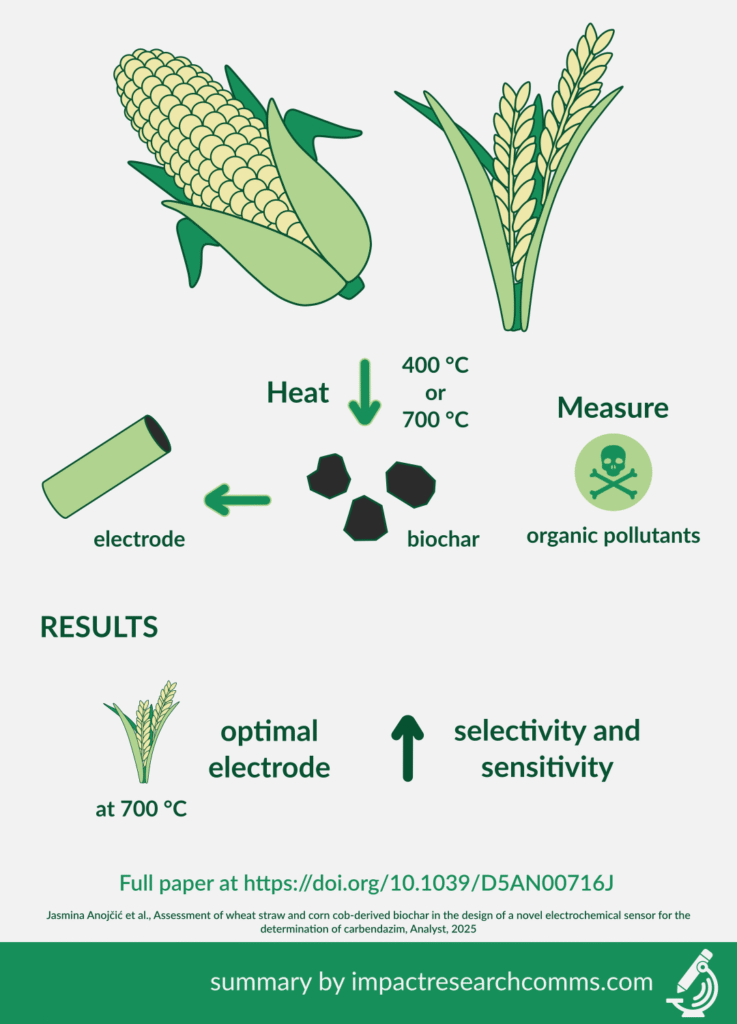
Although wheat and corn typically conjure images of baked goods, a new paper in Analyst shows that, rather than satisfying cravings, they can instead be used to monitor environmental pollutants.
By slowly heating the crops up to 400 °C or 700 °C, the authors formed a dry, carbon-rich charcoal. They then used this charcoal to prepare a series of carbon paste electrodes:
- No charcoal added
- Wheat heated to 400 °C
- Wheat heated to 700 °C
- Corn heated to 400 °C
- Corn heated to 700 °C
Electrode 3 was found to perform best, creating a more sensitive and selective sensor when detecting pollutants from fungicides in water samples.
Why does this matter?
Identifying dangerous pollutants in wastewater and surface water is important to prevent ecosystem damage and health issues. However, the analytical procedures used to investigate samples also needs to be environmentally friendly.
By developing low-cost sensors that are quick and easy to prepare, use leftover agricultural products, with improved analytical capabilities, cheaper and more accurate methods could emerge for monitoring contaminated water sources.
Read the full paper here: https://doi.org/10.1039/D5AN00716J from the Royal Society of Chemistry
Jasmina Anojčić, Sanja Mutić, Tamara Apostolović, Nina Đukanović, Tijana Marjanović Srebro and Jelena Beljin, Assessment of wheat straw and corn cob-derived biochar in the design of a novel electrochemical sensor for the determination of carbendazim, Analyst, 2025