

With Halloween approaching, how can you tell if a skeleton was pregnant?
A direct approach would be to look for fetal remains in the abdomen or pelvis. However, this is rare, as some burial practices surgically removed the fetus from the mother post-mortem.
Instead, to identify pregnancy in human remains, a new paper in Journal of Archaeological Science proposes an archaeological pregnancy test based on hormone markers in bones.
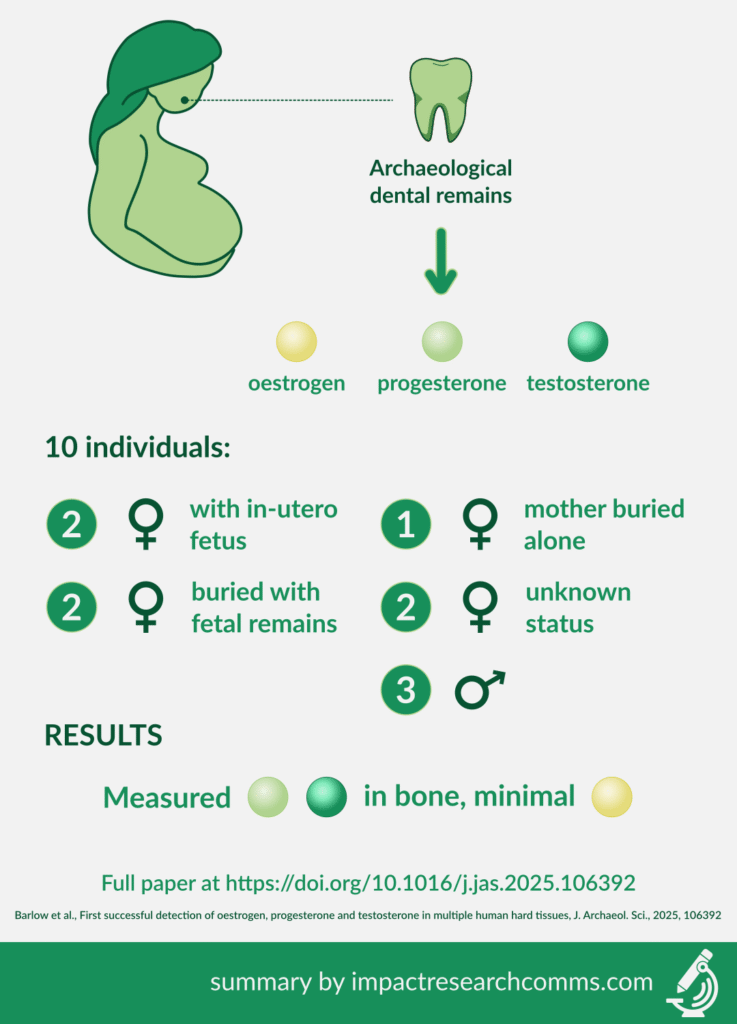
The authors focused on three sex hormones involved in human reproduction: oestrogen, progesterone and testosterone. Remains from ten individuals were tested:
- 2 females with in-utero fetuses
- 2 females buried with fetal remains
- 1 female known to be a mother but buried alone
- 2 females with unknown parity status
- 3 males
Hormones were extracted from teeth and analysed to determine the amount oestrogen, progesterone and testosterone. Progesterone was observed in both males and females, with the highest concentration for one woman with an in-utero fetus. Both women with in-utero fetuses had no detectable testosterone, while two of the males did have detectable testosterone. Oestrogen was only observed in one male and one female.
Why does this matter?
Improving identification of pregnancy in the archaeological record provides a more accurate view of reproductive histories. By extracting and identifying sex hormones from bones, this work suggests that there could be a marker for pregnancy beyond direct observation of fetal remains.
More broadly, hormones play an important role in health and disease. A wider analysis of hormones in human remains opens new possibilities to study past populations.
Read the full paper here: https://doi.org/10.1016/j.jas.2025.106392 from Elsevier
Aimée Barlow, Elizabeth Craig-Atkins, Emilia Barker, Aileen Crawford, Daniela Cacciabue and Katie A. Hemer, First successful detection of oestrogen, progesterone and testosterone in multiple human hard tissues, and their use as potential biomarkers of pregnancy, J. Archaeol. Sci., 2025, 183, 106392