



Should we mix sewage and food?
If the goal is to create a fuel source, then a new paper in Biomass and Bioenergy shows that the answer is yes.
The authors combined sewage sludge, a solid-liquid mixture left over from wastewater treatment, with unprocessed food waste in different ratios. By exposing the mixture of semi-solid wates to conditions found under the Earth’s surface (280 – 320 °C and high pressure, 22.1 MPa), the sludge is converted into a crude oil that can be used as a fuel.
To find the optimal conditions, the ratio of sewage to food waste was varied:
- 9 sewage to 1 food waste
- 7 sewage to 3 food waste
- 1 sewage to 1 food waste
Additionally, three temperatures (280, 300, 320 °C) and three process times (30, 45, 60 minutes) were used to determine the ideal liquefication method. Overall, the best results were found for a 7:3 ratio at 280 °C and 45 minutes. These conditions produced a high-quality biofuel with 99.85% energy recovery.
Why does this matter?
Converting waste into useful products creates a circular economy that reduces both the economic and environmental costs of waste processing and new material production.
The two waste products used in this study, sewage and food waste, are produced globally at an increasing rate. This work shows that there may be a commercially viable pathway to transform these waste items into quality biofuels.
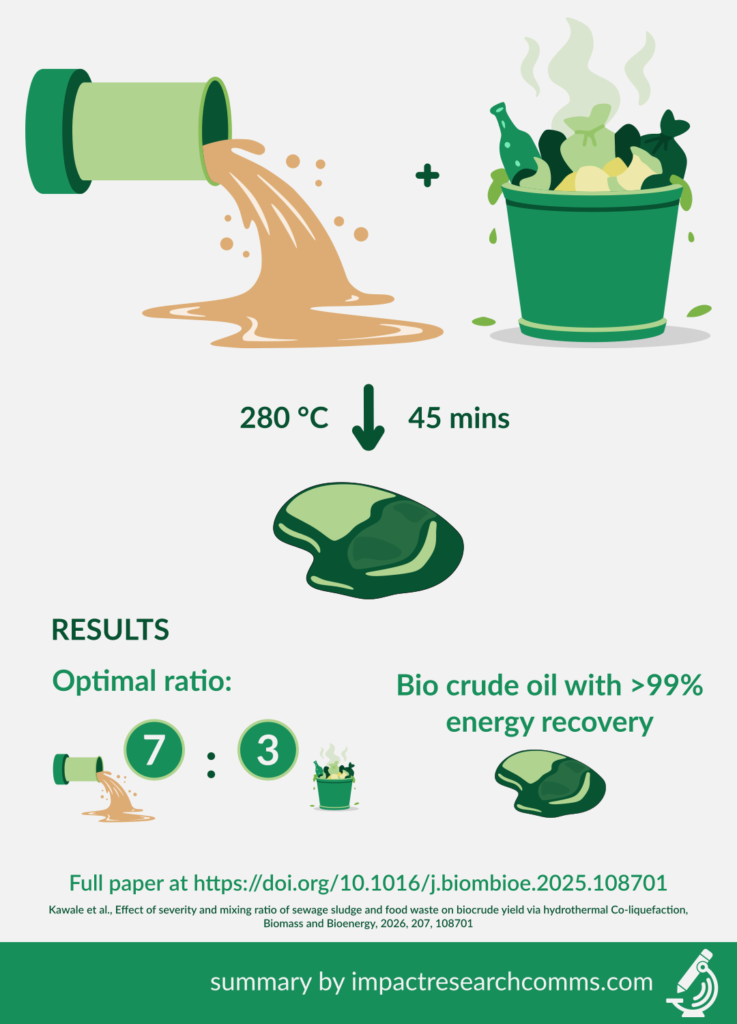
Read the full paper here: https://doi.org/10.1016/j.biombioe.2025.108701 from Elsevier
Harshal D. Kawale, Sabrina Summers, Zixin Wang and Yuanhui Zhang, Effect of severity and mixing ratio of sewage sludge and food waste on biocrude yield via hydrothermal Co-liquefaction, Biomass and Bioenergy, 2026, 207, 108701