



Whenever you raise a toast, your glass of wine tells the story of how forever chemicals spread throughout the environment.
During growth, winemaking grapes absorb polyfluoroalkyl substances (PFAS) through their roots. These chemicals bioaccumulate during processing into wine, with some vintages staying in storage for decades. As a result, by analysing wine bottled over a 78-year timespan, a new paper in Environmental Sciences and Technology offers a unique insight into how forever chemical contaminants have changed since World War II.
The authors focused on the smallest type of PFAS: trifluoroacetate (TFA). Using a combination of low- and high-resolution mass spectrometry, they analysed the concentration of TFA in 150 wine samples from a single winery in Germany, covering dates from 1946-2025.
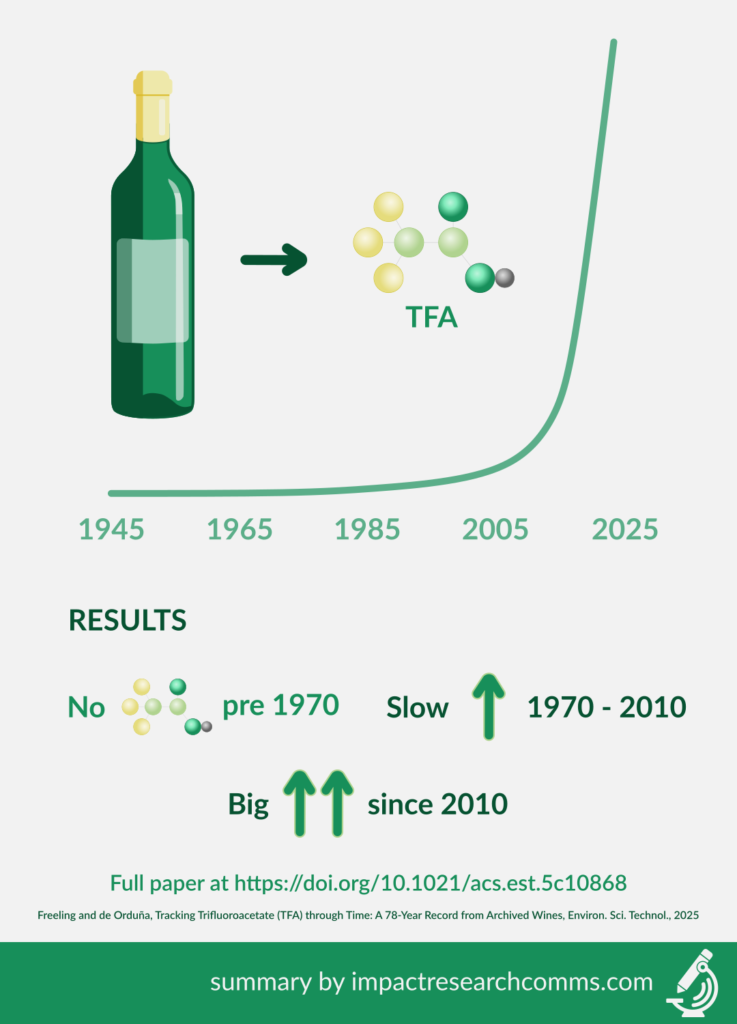
The results showed that:
- There was no detectable TFA in wine pre-1970
- Between 1970 and 2010 there was a moderate increase in TFA
- Since 2010, TFA concentrations have increased rapidly
Why does this matter?
PFAS are a growing public health concern, making it important to understand how humans are exposed from dietary sources in plant-based food and drink. Wine is a good proxy for monitoring changes in environmental concentrations of PFAS over time because the amount present in a bottle is determined by the concentration in the soil when the grapes were growing.
By studying vintages covering the post-war era, this work shows that TFA in soil has increased over the past 78 years. As a result, it gives details about how forever chemicals have spread throughout modern environments.
Read the full paper here: https://doi.org/10.1021/acs.est.5c10868 from the American Chemical Society
Finnian Freeling and Ramón Mira de Orduña Heidinger, Tracking Trifluoroacetate (TFA) through Time: A 78-Year Record from Archived Wines, Environ. Sci. Technol., 2025