


If you remove a mummy from its burial site, beyond triggering an ancient curse, you could cause changes to the chemical make-up of the remains.
While some of these changes may be inadvertent, during the 19th century, alterations were intentionally made for restoration or to increase sale prices. Although piecing together the post-mortem history of a mummy can be complicated, a new paper in Journal of Analytical Atomic Spectrometry shows that the recent experiences of a mummy can be just as interesting as its ancient origin story.
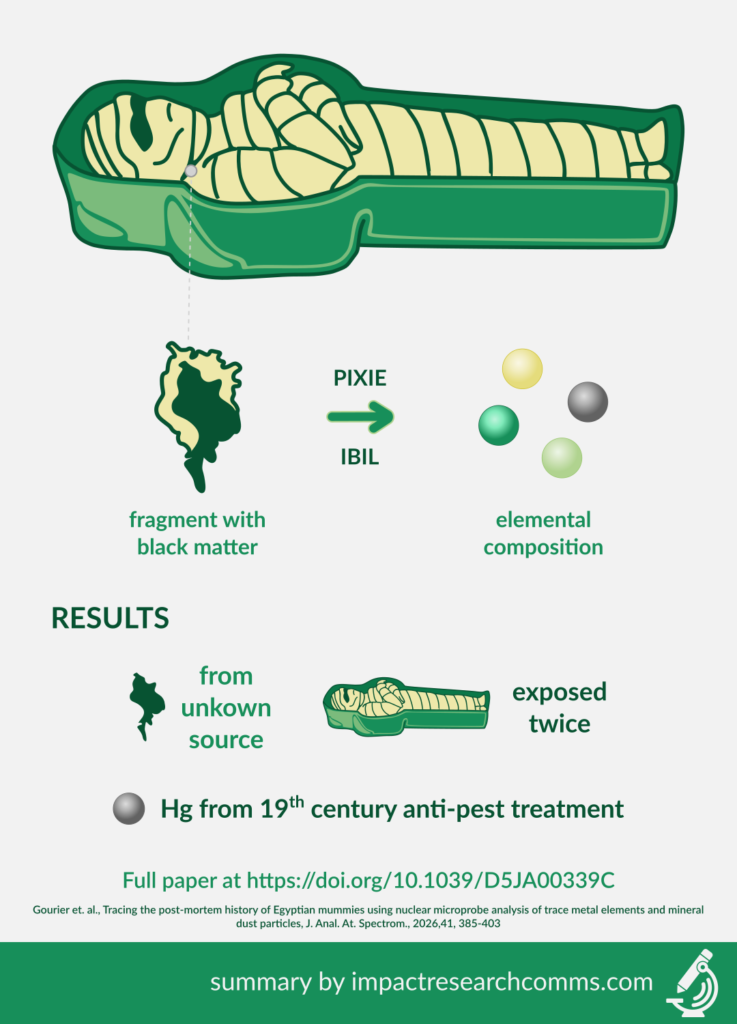
Focusing on an Egyptian mummy of an unknown man, the authors analysed fragments of strips covered in black matter taken from the head and neck area. The black residue was found to be made of pure bitumen, different to the complex natural mixtures typically used for embalming in ancient Egypt .
To investigate if this was a more recent addition, the strips were studied using a combination of X-ray emission and luminescence. Comparing the elemental composition to 15 previously studied Egyptian mummies (9 birds, 2 rams, 1 crocodile, 1 human), it was found that:
- The bitumen layer was not from the dead sea
- Airborne dust on the samples contained Egyptian blue
- The dust distribution suggests two exposure events
- A high concentration of mercury was present
Overall, these observations suggest that the black residue was applied in antiquity, but the bitumen came from an unusual, unknown source. The mummy was exposed twice, first during preparation in South Egypt and later during excavation in North Egypt. In the early 19th century, an undocumented mercury treatment was applied to protect the mummy from pests.
Why does this matter?
Understanding the treatments applied to ancient remains can help identify the best approach to protect and preserve the mummy for the future. This work shows how elemental compositions can be used to trace the complex history of mummies with unknown histories.
Read the full paper here: https://doi.org/10.1039/D5JA00339C from the Royal Society of Chemistry
Didier Gourier, Oceane Anduze, Quentin Lemasson, Laurent Pichon, Thomas Calligaro, Agnes Lattuati-Derieux and Laurent Binet, Tracing the post-mortem history of Egyptian mummies using nuclear microprobe analysis of trace metal elements and mineral dust particles, J. Anal. At. Spectrom., 2026, 41, 385-403