



Hematite is an iron oxide that occurs naturally around the world. Because of its abundance, it has been used by humans since prehistory, first as the pigment red ochre, then as an ore for smelting iron, and now in emerging technologies for catalysis and energy storage.
But how can you tell where hematite comes from?
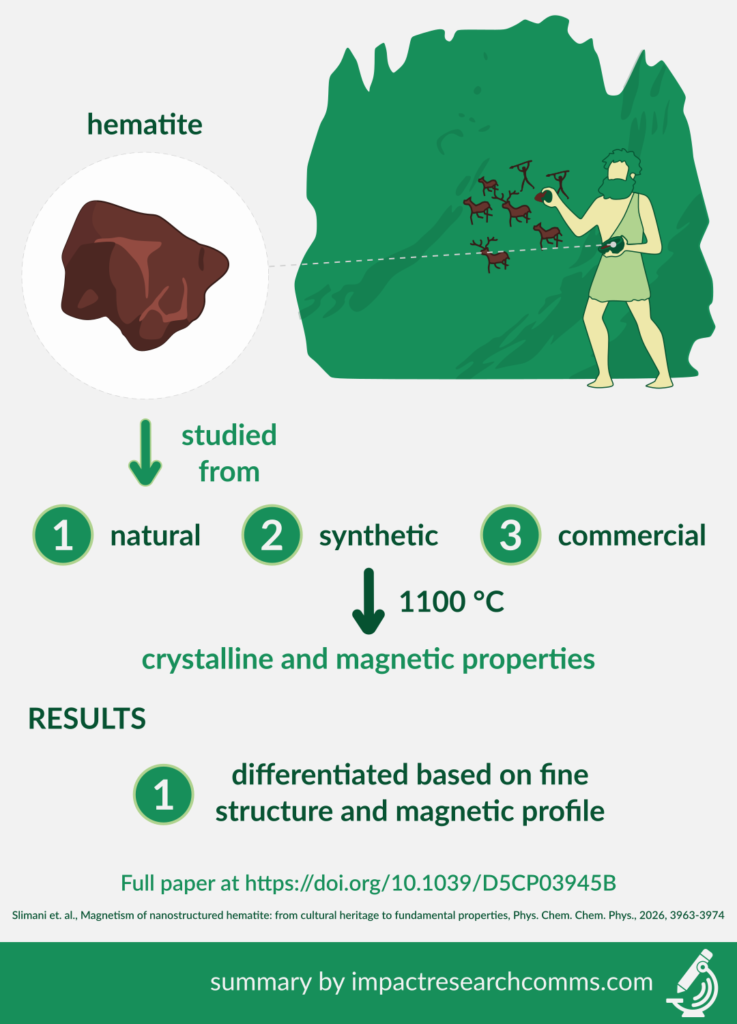
A new paper in Physical Chemistry Chemical Physics explores this question by comparing the crystal structure and magnetic properties of hematite from three contexts:
- Natural hematite from Italy
- Synthetic hematite made in the laboratory
- Commercially available hematite pigment
Using a combination of diffraction, microscopy, and magnetic measurements, the authors characterised the three samples before and after heating to 1100 °C, which simulated changes in archaeological hematite.
With microscopy and diffraction alone, the natural and synthetic pigments could not be differentiated. However, the natural hematite showed a more complex magnetic profile due to the presence of multiple magnetic phases, and the crystal fine structure was different.
Why does this matter?
Determining the provenance of ancient materials provides knowledge about technological developments, behaviour, and trade networks of the past. Hematite is one of the oldest minerals used by humans and can be found worldwide. As a result, studying small differences in hematite’s magnetic properties could reveal new insights into prehistoric cultures.
Read the full paper here: https://doi.org/10.1039/D5CP03945B from the Royal Society of Chemistry
Sawssen Slimani, Alberto Martinelli, Alexander Omelyanchik, Maryam Abdolrahimi, Elena Castagnotto, Pierfrancesco Maltoni, Sara Laureti, Gianni Barucca, Nader Yaacoub, Federico Locardi, Arooj Ramzan, Laura Gaggero, Maurizio Ferretti and Davide Peddis, Magnetism of nanostructured hematite: from cultural heritage to fundamental properties, Phys. Chem. Chem. Phys., 2026,28, 3963-3974