


How do microplastics interact with forever chemicals?
Microplastics — small plastic particles measuring <5 mm — and highly stable polyfluoroalkyl substances (PFAS), are coming to public attention for their potential environmental and health risks. With these contaminants occurring more frequently in natural environments, a new paper in the Journal of Physical Chemistry B explores what happens when they meet.
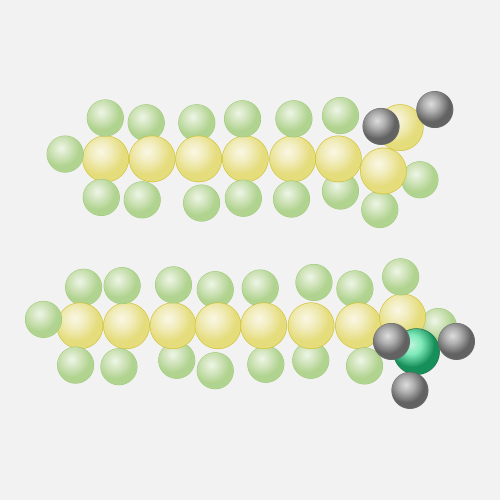
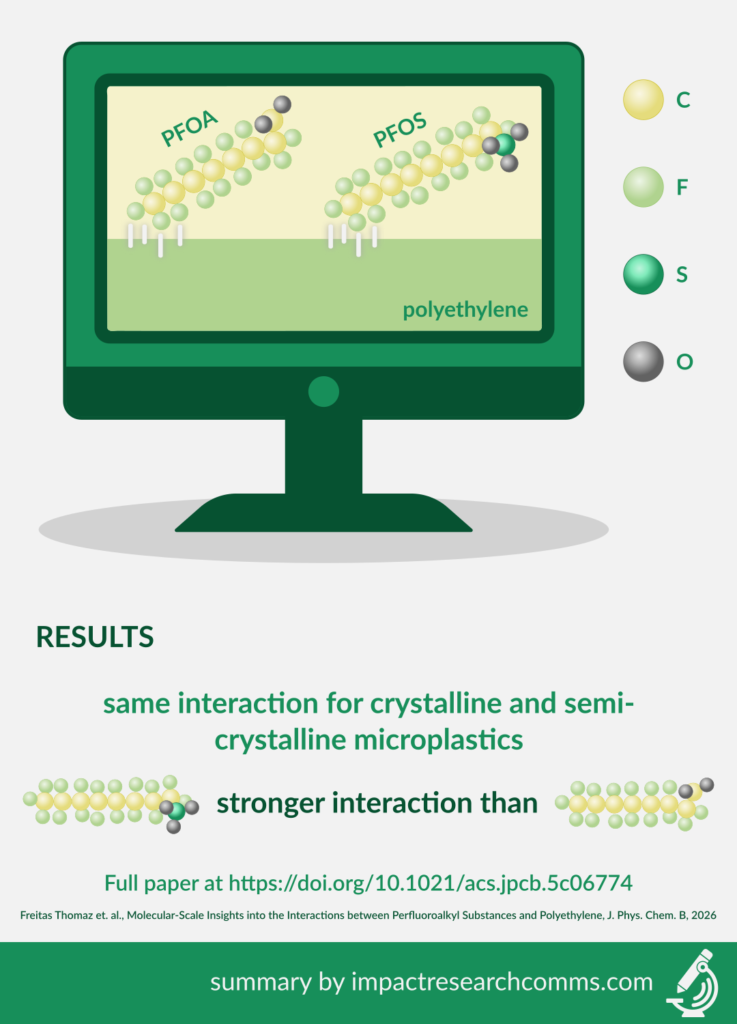
Using molecular dynamic simulations, the authors modelled the molecular-scale interactions between polyethylene and two PFAS:
- perfluorooctanoic acid (PFOA)
- perfluorooctanesulfonic acid (PFOS)
Comparing results for a crystalline and semi-crystalline polyethylene surface, the morphology of the plastic did not change the interactions. However, for both types of polyethylene, PFOS interacted more strongly than PFOA.
Looking closer at the molecular orientation during interactions, there was a preference for the tails of the PFAS molecules to align parallel to the polyethylene chains.
Why does this matter?
The different interactions observed for the two forever chemicals suggest the chemical composition of a PFAS impacts its reactivity, which is also orientation dependent. More broadly, the observed interactions between single molecules of microplastics and PFAS may enable microplastics to be used as PFAS reservoirs, helping to transport, monitor and remove forever chemicals from the environment.
Read the full paper here: https://doi.org/10.1021/acs.jpcb.5c06774 from the American Chemical Society
Dandara Freitas Thomaz, Eduardo Rocha de Almeida Lima and Nathalia Salles Vernin, Molecular-Scale Insights into the Interactions between Perfluoroalkyl Substances and Polyethylene, J. Phys. Chem. B, 2026