



[Originally posted on LinkedIn on 8th August 2025]
To mark international cat day, I’m sharing a paper published last week in Environmental Science & Technology that explores how the lifestyle of a cat impacts the microorganisms found in its gut.
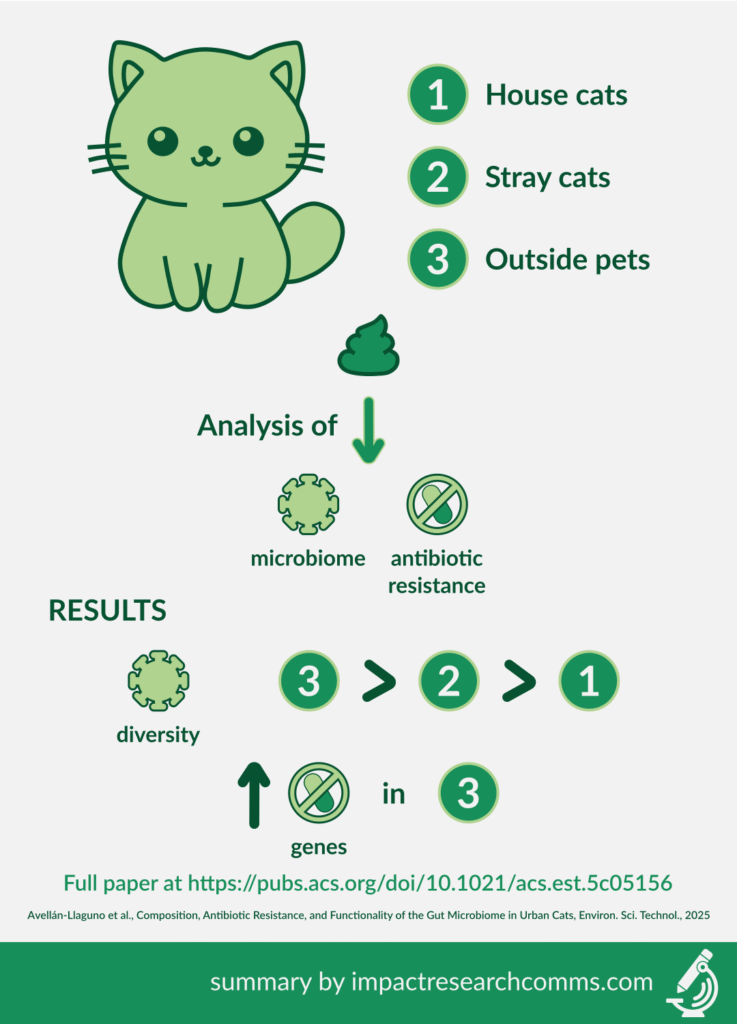
In the study, 3 groups of cats were investigated:
- House cats
- Stray cats
- Pet cats that go outside
The authors collected stool samples from each group and found differences in the number of microorganism species present depending on the cat’s lifestyle. Pet cats that go outside (group 3) had the highest diversity, followed by stay cats (group 2), with house cats (group 1) showing the least diversity.
Why does this matter?
First, it shows that pet cats who go outside have the most varied diets, eating cat food, hunting and scavenging, which helps keep rodent populations in check.
However, gut microorganism diversity wasn’t the only variable found to be higher in outside-roaming pets.
Samples from these cats also had a greater number of antibiotic resistance genes, suggesting they may play a role in spreading antibiotic resistance throughout the environment.
With antibiotic resistance on the rise and presenting public health concerns, this work shows that our cats may have a role to play in future strategies to prevent the spread of antibiotic resistance.
Read the full paper here: https://pubs.acs.org/doi/10.1021/acs.est.5c05156 from the American Chemical Society
Avellán-Llaguno et al., Composition, Antibiotic Resistance, and Functionality of the Gut Microbiome in Urban Cats, Environ. Sci. Technol., 2025