



[Originally posted on LinkedIn on 12th September 2025]
In the winter of 1609, colonists in Jamestown, Virgina, were running out of food, starving and besieged.
To survive, they were forced to consume animals brought to the new world and discarded their remains in a well. Now, over 400 years later, a new paper in Science Advances uses these bones to provide a unique insight into animal exchange, transport and use in the early modern period.
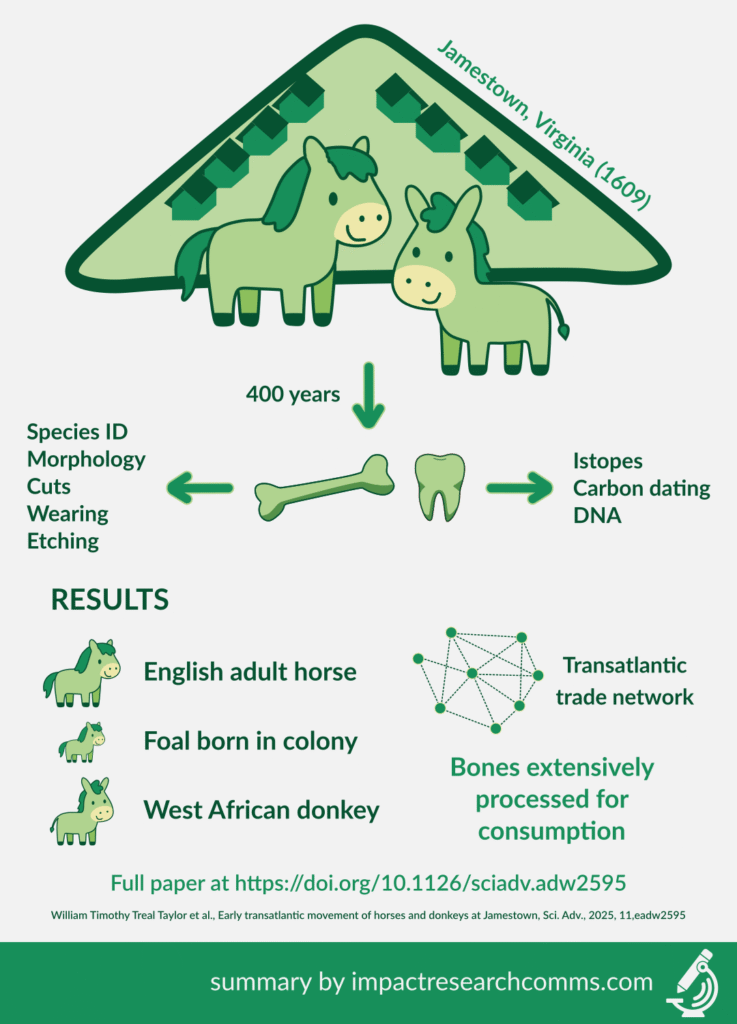
The study focuses on equid bones dated to the winter of 1609. Among the bones, the authors identified:
- Adult horses transported from England
- A young foal born in the colony
- A donkey, likely of West African origin, purchased en route
All remains show evidence of extensive processing, including butchering, cooking and marrow removal, to provide the maximum nutrition. Examination of teeth also indicated bridling of the horses.
Why does this matter?
These results support written documents from the time, which recorded transatlantic horse transport to Jamestown. Going beyond written evidence, the material remains also show that horses were likely used for transportation, while the presence of a young foal indicates that colonists had set up a successful breeding programme before the starving winter.
Additionally, the discovery of a donkey purchased during the voyage gives a glimpse into the transatlantic animal trade, revealing a complex network connecting Europe, Africa and the Americas via the Caribbean.
Read the full paper here: https://doi.org/10.1126/sciadv.adw2595 from AAAS
William Timothy Treal Taylor, Nicolas Delsol, Vicky M. Oelze, Peter Mitchell, Leah Stricker, Michael Lavin, Akin Ogundiran, Lauren Hosek, Christina Isabelle Barrón-Ortiz, Olumide Ojediran, Diana Quintero-Bisono, Lucy Keith-Diagne, Dane Magoon, Matthew E. Hill Jr., Ariane E. Thomas, Anna Waterman, David W. Peate, Lorelei Chauvey, Stéphanie Schiavinato, Laure Calvière-Tonasso, Luís Borges, Aitor Brito-Mayor, Jonathan Santana, George Kamenov, Ludovic Orlando, and John Krigbaum, Early transatlantic movement of horses and donkeys at Jamestown, Sci. Adv., 2025, 11, eadw2595