



[Originally posted on LinkedIn on 16th September 2025]
As the Bronze Age transitioned into the Iron Age, a technological division occurred between China and the West.
While western blacksmiths worked by hammering hot, solid-state pure iron into desired objects, Chinese smiths cast liquid, carbon-containing iron into a mould to mass-produce items. Cast iron didn’t emerge in the West until 2000 years later, where it became a wonder material at the heart of the industrial revolution. But why did these two regions develop iron so differently?
A new paper published in Internet Archaeology explores this question by comparing the social and political contexts in each area at the dawn of the Iron Age.
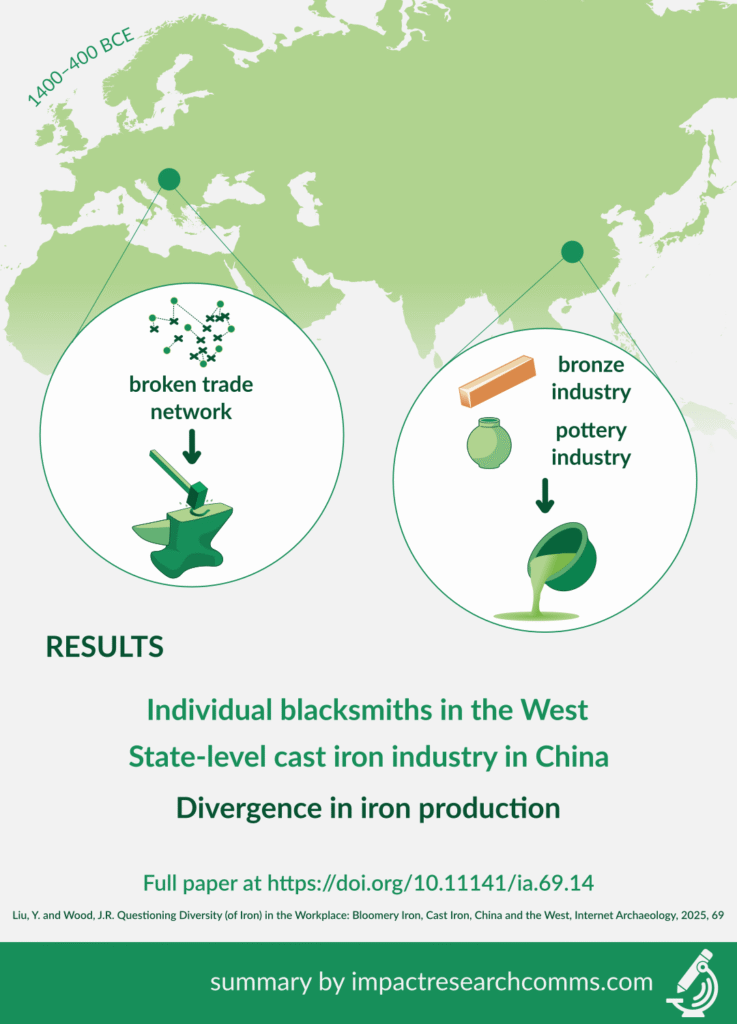
Although both regions had the same technological capabilities when entering the Iron Age, the authors observed a key difference between the two regions:
- Trade networks in the West were disrupted by the Bronze Age collapse
- In China, the bronze and pottery industries remained strong
As a result, the technological development in the West depended on individual craftsman in the absence of strong trade. By contrast, in China, where trade remained intact, interaction with techniques from bronze and pottery production let to the development of cast iron.
Why does this matter?
This investigation shows how small differences at the start of technological development can have a large impact on the adoption, use and trajectory of an industry. In China, iron became associated with agricultural objects and mass-produced tools, while the West used iron for both cheap nails and prestigious swords.
More broadly, the difference in iron manufacture influenced the societal structures in both regions. The Chinese industry was centrally controlled by the state, while Western industry depended more on individual smiths, a contrast which echoes into the modern era.
Read the full paper here: https://doi.org/10.11141/ia.69.14 in Internet Archaeology from University of York
Yaxiong Liu and Jonathan R. Wood, Questioning Diversity (of Iron) in the Workplace: Bloomery Iron, Cast Iron, China and the West, Internet Archaeology, 2025, 69