



[Originally posted on LinkedIn on 25th August 2025]
Is it possible to make a synthetic cell?
Although artificial cells can emulate several key biological functions, some properties remain elusive. In a biological system, cells can move around. However, designing a mobile synthetic cell that doesn’t disintegrate during motion has proved challenging. Until now.
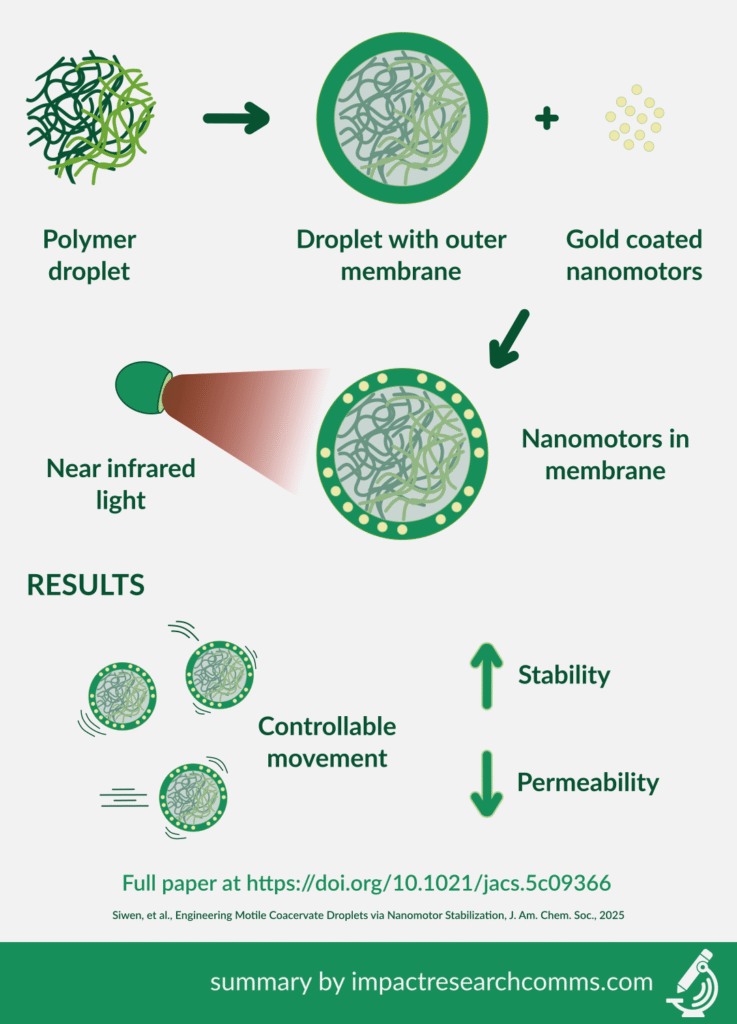
A new paper in JACS shows that by embedding gold-coated nanomotors into the membrane of a polymer droplet, it is possible to produce an artificial cell that can move. The authors were able to control this movement by shining a laser onto the cells.
Adding nanomotors to the membrane layer also:
- made the membrane less permeable
- stabilised the overall cell structure
Why does this matter?
Creating artificial cells that can mimic living counterparts could lead to advances in synthetic biology, with applications in medicine and biotechnology, for example as a new way of delivering drug molecules into the body.
Additionally, the process of building a synthetic cell may provide new, fundamental insights into the properties and behaviour of living cells, to better understand health and disease.
Read the full paper here: https://doi.org/10.1021/jacs.5c09366 from the American Chemical Society
Sun Siwen, Shukun Li, Tania Patiño Padial, Jan van Hest, et al., Engineering Motile Coacervate Droplets via Nanomotor Stabilization, J. Am. Chem. Soc., 2025