
[Originally posted on LinkedIn on 5th September 2025]
Microplastics are increasingly coming to public attention as harmful contaminants that accumulate in environments and food chains. However, micron-sized particles (1μm – 5 mm) may not be the most concerning type of plastic debris.
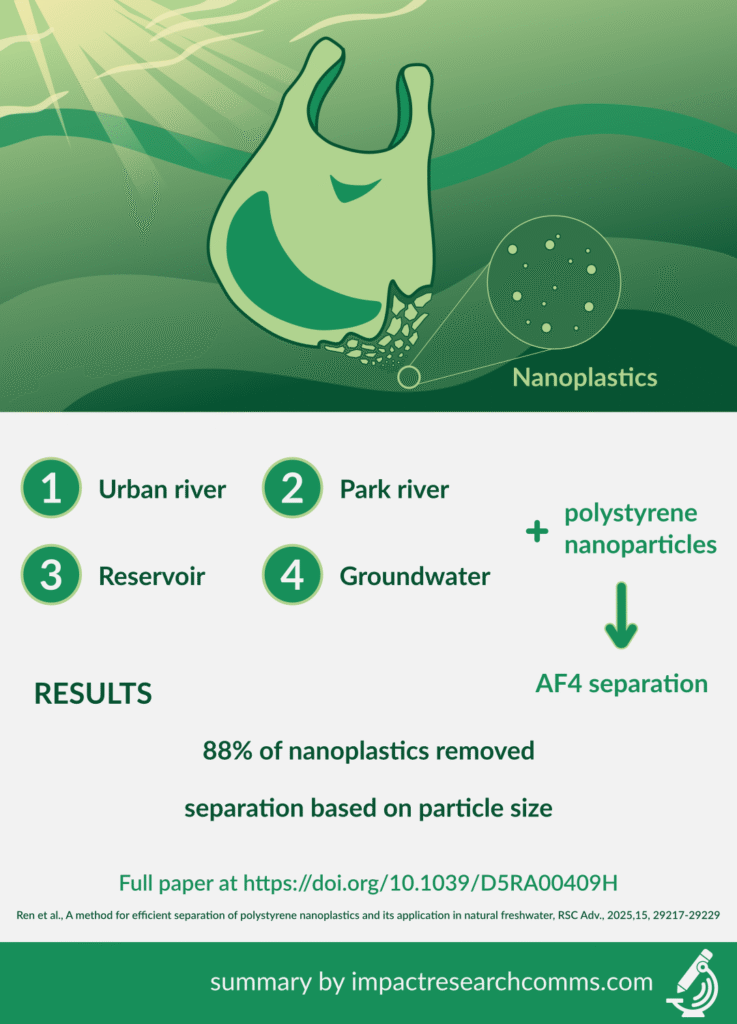
When microplastics degrade, they form even smaller, nanoscale particles. These tiny nanoplastics are much harder to detect than their larger counterparts but pose greater health risks. If nanoplastics pollute freshwater, removing them becomes a technical challenge; an issue explored in a new paper in RSC Advances.
In the study, the authors added a known concentration of polystyrene nanoparticles, sized 50 to 100 nm, to water samples from four different sources:
- River in an urban area
- River in a natural park
- Reservoir water
- Groundwater
Samples were passed through a flow-based separation channel with a cellulose membrane to extract the nanoparticles. By optimizing the setup, 88% of the polystyrene was removed and separated based on particle size.
Why does this matter?
As complex, real-world water samples were used, it shows that the filtration approach can be applied to remove nanoplastics from freshwater. Additionally, as the physical and chemical properties of nanoparticles change depending on their size, the ability to separate and characterise nanoplastics based on particle size could provide new insights into the impact of nanoplastics on water sources, ecosystems and health.
Going beyond polystyrene, the optimised filtration method may also be applied to other types of nanoscale plastic waste.
Read the full paper here: https://doi.org/10.1039/D5RA00409H from the Royal Society of Chemistry
Pengju Ren, Shusheng Luo, Lijuan Wang, Yihan Chi and Yuanyuan Tang, A method for efficient separation of polystyrene nanoplastics and its application in natural freshwater, RSC Adv., 2025,15, 29217-29229