


[Originally posted on LinkedIn on 14th October 2025]
Could there be contaminants in a bowl of cornflakes?
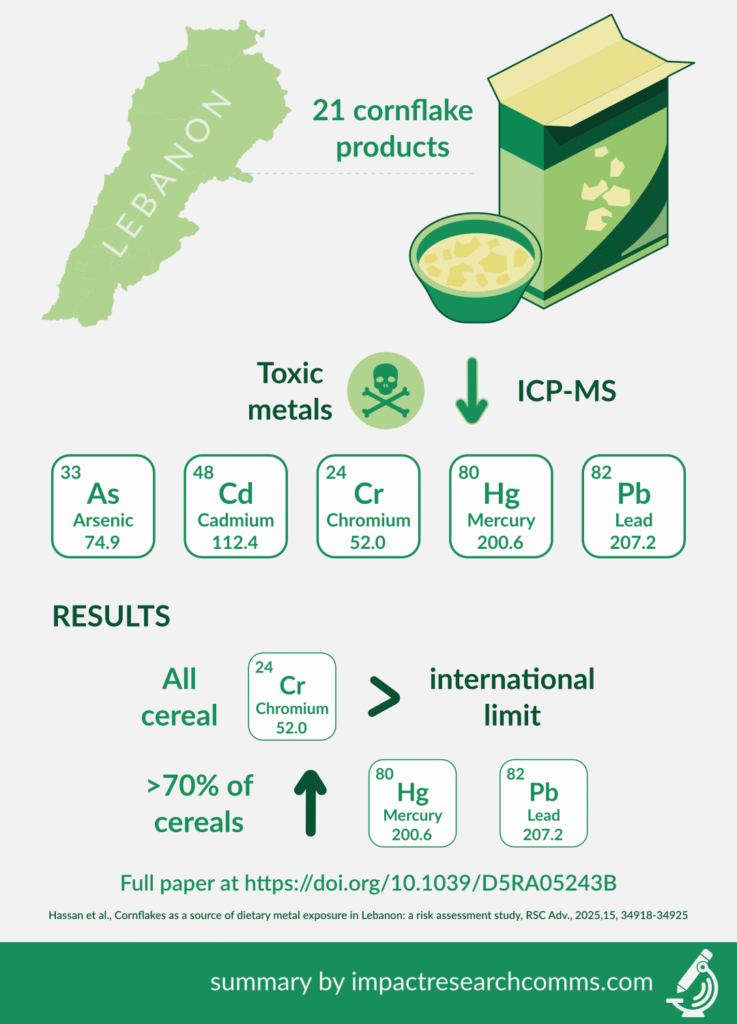
A new study in RSC Advances explores this question by quantifying toxic metals in cornflake products sold in Lebanon.
The authors collected 21 cereals, sold by a range of manufacturers with different countries of origin, across two production periods (42 samples total). Analysis of the elemental composition of the samples focused on five toxic metals:
- Arsenic
- Cadmium
- Chromium
- Mercury
- Lead
All samples were found to exceed the international limits for chromium, with over 70% also containing high amounts of lead and mercury. However, the concentration of all 5 metals were below Lebanese national limits.
Why does this matter?
Toxic metals can enter the food chain through contaminated water, soil or air. When consumed, they can accumulate in the body, potentially causing organ damage, cardiovascular disease and cancer. As a result, it is important to monitor the quantity of toxic metals in food products at both the national and international level.
For cornflakes in Lebanon, this study suggests that, although the products adhere to national standards and don’t exceed international safety levels for adult consumption, the concentrations were higher than recommended internationally, which could present a public health concern, particularly for children.
Read the full paper here: https://doi.org/10.1039/D5RA05243B from the Royal Society of Chemistry
Hussein F. Hassan, Celine El Khoury, Fatima Haydous, Hani Dimassi, Maria Abou Abdallah, Mireille Serhan and Elias Akoury, Cornflakes as a source of dietary metal exposure in Lebanon: a risk assessment study, RSC Adv., 2025,15, 34918-34925