



After trick or treating tonight, you may find yourself overflowing with sweets. Instead of throwing this waste food away, what if you could convert it into aeroplane fuel?
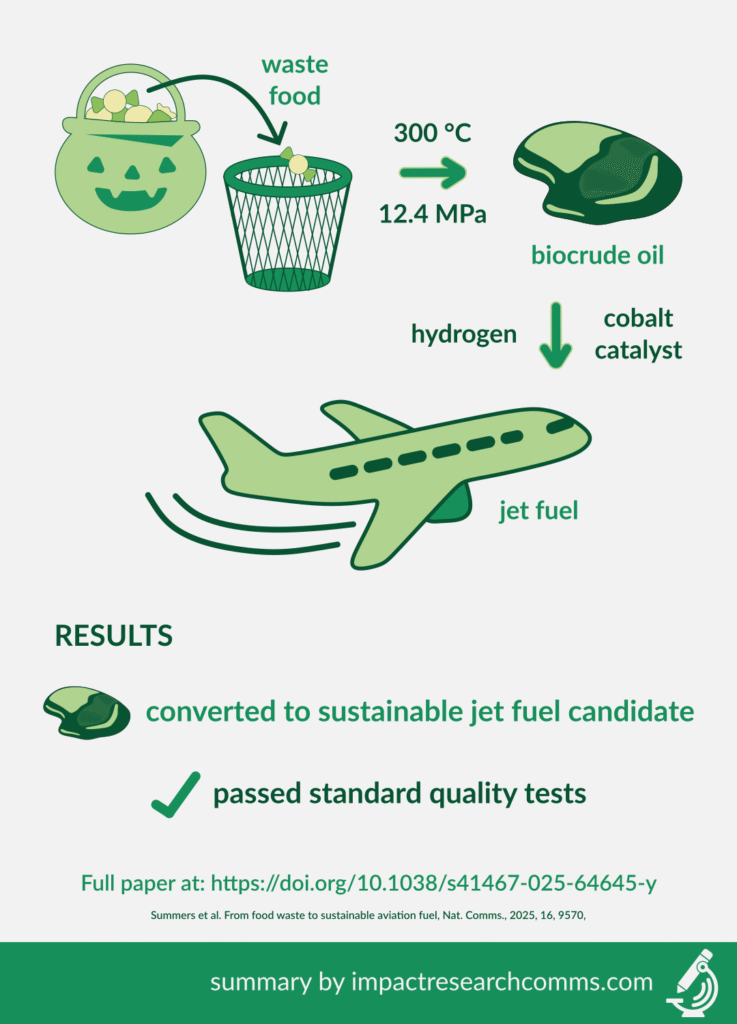
This idea is explored in a new paper in Nature Communications, where high temperature (300 °C) and pressure (12.4 MPa) were used to convert wet food waste into a biocrude oil. However, just like regular crude oil, biocrude oil requires additional treatment before it can become a useable fuel.
To create a fuel, the authors first removed impurities such as salt, water and ash. They then developed a single-step refinement process using hydrogen and a cobalt molybdenum catalyst, optimising the process by adjusting different refinement parameters:
- temperature
- amount of hydrogen
- amount of catalyst
- retention time
By carefully tuning the variables, a sustainable aviation fuel was produced. This new fuel candidate passed standardised quality tests, making it a viable jet fuel without the need for additives or blending with a conventional fuel.
Why does this matter?
Turning waste into useable products can reduce carbon emissions and promote a circular economy by recycling materials from one industry to another. With almost a third of food wasted annually, this work shows that there are plenty of leftovers available to feed hungry aeroplanes.
Read the full paper here: https://doi.org/10.1038/s41467-025-64645-y from Springer Nature
Sabrina Summers, Siyu Yang, Buchun Si, Zixin Wang, Jamison Watson, Siying Yu, Zhibin Yang, Harshal Kawale, Joshua S. Heyne and Yuanhui Zhang, From food waste to sustainable aviation fuel: cobalt molybdenum catalysis of pretreated hydrothermal liquefaction biocrude, Nat. Comms., 2025, 16, 9570