



Beauty sleep is widely considered to be essential for glowing, healthy skin.
Throughout the day, our bodies cycle through sleep and wakefulness based on circadian rhythms. But how the skin changes based on this master clock is not clear. A new paper in Analyst explores this question by monitoring fats found inside skin cells over a 24-hour period.
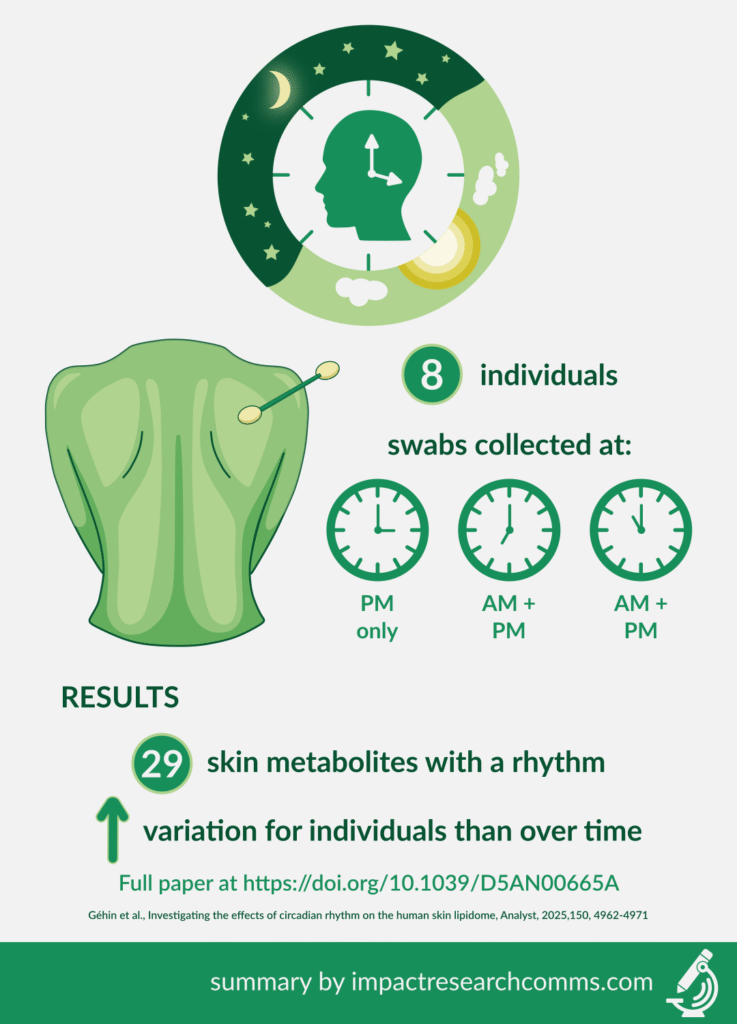
The authors asked 8 individuals to swab their upper back for five consecutive days, at times:
- 7:00 – 8:00
- 11:00 – 12:00
- 15:00 – 14:00
- 19:00 – 20:00
- 23:00 – 0:00
Across the 208 collected sampled, 29 molecules were found to have a rhythm for all participants, representing a tiny 0.67% of all molecules identified in the swabs. However, there was more variation between individuals than across the timepoints, with some participants having up to 18% of their molecules rhythmically linked.
Why does this matter?
Understanding how timing impacts skin could help to tailor medical treatments or cosmetics to protect the largest human organ. This work indicates that there is a timing component to the cellular composition of skin cells.
Beyond skin, this study found that averaging results across a group removed trends that are present at an individual level. As a result, to investigate very complex clinical presentations, such as skin profiles, personalised data may provide more information than group-level studies.
Read the full paper here: https://doi.org/10.1039/D5AN00665A from the Royal Society of Chemistry
Caroline Géhin, Amanda V. Witter, Lu Wang, Perdita E. Barran, Stephen J. Fowler and Drupad K. Trivedi, Investigating the effects of circadian rhythm on the human skin lipidome, Analyst, 2025,150, 4962-4971